Parlay or Pass? Breaking Down the Real Math Before You Chase That Big Payout
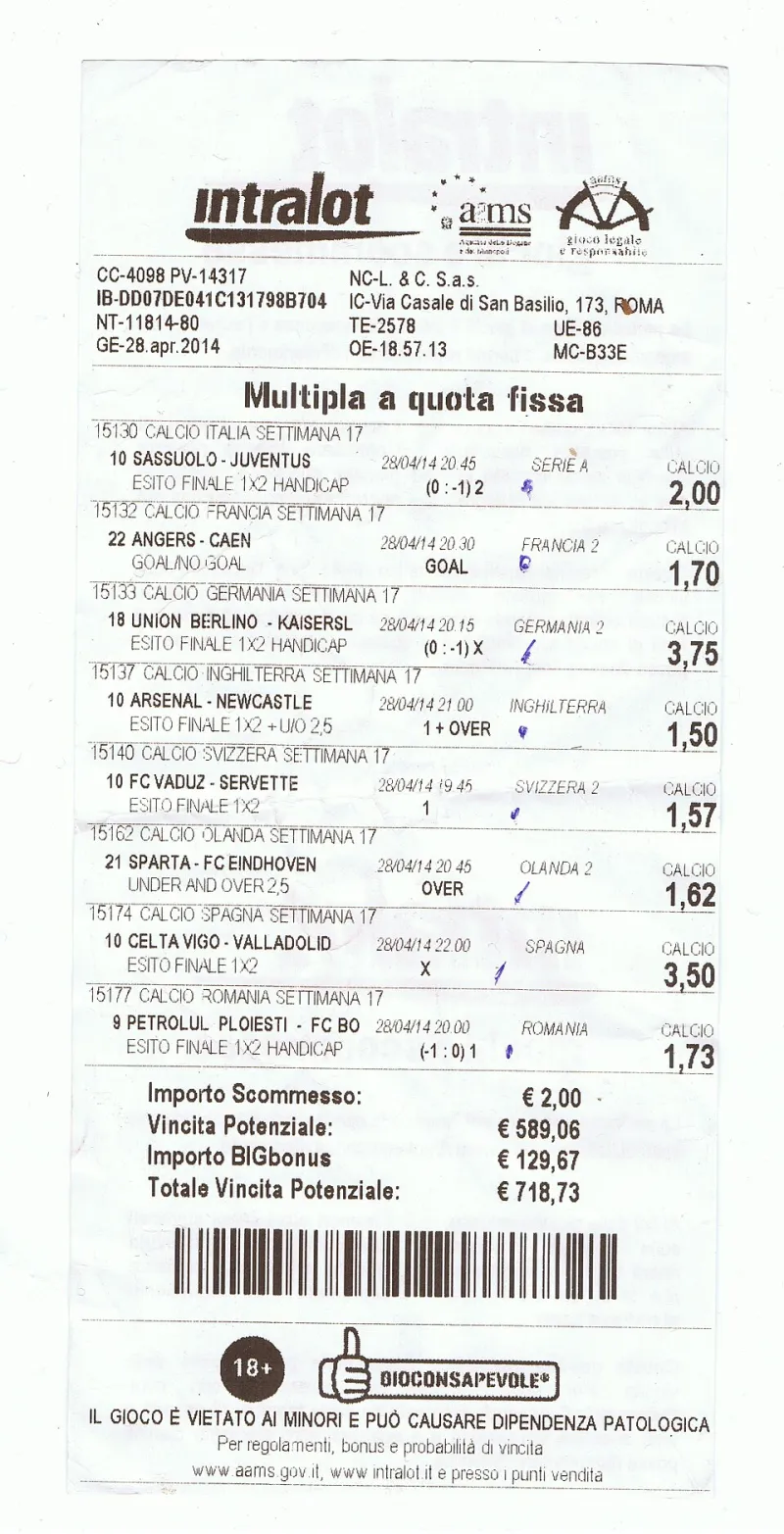
Photo: Nicholas Gemini, CC BY-SA 3.0, via Wikimedia Commons
Few things in sports betting fire up a group chat faster than a parlay ticket. Four legs, eight legs, a same-game parlay on Sunday Night Football—the screenshots go viral, the payouts look insane, and suddenly everyone wants in. And honestly? That excitement is part of what makes betting fun.
But there's a version of this conversation that doesn't get nearly as much airtime: the math. What do parlays actually do to your expected return? When does stringing bets together make strategic sense, and when are you just handing the house extra margin? Let's get into it.
The Straight Bet Baseline: Simple, Clean, Efficient
Before you can evaluate parlays, you need a clear picture of what you're comparing them to. A standard straight bet—one game, one wager—is the most efficient bet structure available at most US sportsbooks.
At the standard -110 odds you'll see on most spreads and totals, you need to win 52.4% of your bets just to break even. That's your baseline. Every strategy, every bet type, every system you use should be measured against that number.
The house edge on a -110 straight bet is roughly 4.5%. That's the sportsbook's built-in margin—the price you pay to play. It's real, it compounds over time, and it's why long-term profitability in sports betting is genuinely difficult.
Straight bets are clean because their math is transparent. You know exactly what you're paying and what you need to win. That clarity is worth something.
How Parlay Math Actually Works
A parlay combines two or more bets into a single wager, with each leg needing to win for the ticket to cash. The appeal is obvious: a two-team parlay pays around +260, a three-teamer around +600, and the numbers keep climbing from there.
Here's where it gets interesting—and a little uncomfortable. When a sportsbook calculates a parlay payout, they don't simply multiply the true odds of each leg together. They multiply the reduced odds, the ones that already have the house edge baked in.
Let's say you're parlaying two -110 bets. Each leg has a true implied probability of about 52.4%. The probability of winning both is 52.4% × 52.4%, which equals roughly 27.5%. A fair payout for that would be around +264. Most books pay around +260. That gap—small on two legs—grows significantly as you add more legs.
By the time you're building a six-team parlay, the house edge has compounded to somewhere between 15% and 40% depending on the sportsbook and the specific legs involved. You're not just paying the vig once—you're paying it on every single leg, stacked on top of each other.
When Parlays Aren't Just a Sucker Bet
Here's where the conversation gets more nuanced. Parlays aren't always mathematically indefensible—it depends on what you're trying to accomplish and how you're building them.
Correlated parlays are the clearest case where the math can shift in your favor. A correlated parlay is one where the outcomes of the legs are genuinely connected. For example: betting that a certain NFL team wins and that the game goes over the total. If that team tends to win high-scoring games, those two outcomes aren't independent—they're linked. Some sportsbooks restrict or ban correlated parlays for exactly this reason, but same-game parlays on platforms like DraftKings and FanDuel have opened up new opportunities here.
Reduced-juice parlays at books offering -105 lines instead of -110 also change the calculus meaningfully. Lower vig on each leg means the compounding works against you less aggressively.
Small parlays as entertainment allocation is a legitimate use case too. If you're setting aside $20 for a Sunday of football and you want a shot at turning it into $200, a three-team parlay is a rational way to deploy that entertainment budget—as long as you're clear-eyed about what you're doing.
Expected Value: The Number That Doesn't Lie
Expected value (EV) is the clearest lens for comparing any two bet types. It's the average return you'd expect per dollar wagered over a large sample.
For a -110 straight bet with no edge: EV is slightly negative, around -$0.045 per dollar.
For a two-team parlay at -110 per leg: EV is around -$0.065 per dollar.
For a four-team parlay: EV typically drops to somewhere between -$0.10 and -$0.15 per dollar, depending on the book.
The takeaway is straightforward: as you add legs, expected value decreases. Every additional leg is another layer of house margin sitting on top of the last one.
The exception—and this is important—is when you have a genuine edge on individual legs. If you believe a line is mispriced and you're betting it because of that edge, a parlay with two mispriced legs can actually amplify your positive EV. This is how sharp bettors use parlays strategically: not to chase big payouts, but to stack identified edges.
The Psychological Trap: Variance as a Feature
Parlays are engineered to feel like they're almost winning. You go 4-1 on a five-teamer and walk away with nothing, but the feeling is almost identical to going 5-0—which is exactly the point. That near-miss sensation keeps players coming back to rebuild the ticket.
Straight bets, by contrast, offer more frequent feedback—wins and losses that accumulate into a trackable record. That's less exciting in the short term but far more useful for anyone trying to build a sustainable betting approach.
If you find yourself consistently building six and seven-leg parlays because the individual games don't feel exciting enough on their own, that's worth paying attention to. The game has gotten ahead of the strategy.
So, Which One Should You Actually Use?
The honest answer is: both, but deliberately.
Straight bets should be your foundation. They offer the best expected value, the clearest feedback loop, and the most sustainable path to long-term profitability. If you're tracking your bets and trying to build a real edge, straight bets are where that edge shows up most clearly.
Parlays have a place in your toolkit—specifically for correlated opportunities, reduced-juice lines, and small entertainment-budget plays where variance is the point. What they shouldn't be is your primary strategy, or a way to make losing weeks feel recoverable.
At Fly88B, we're all about bold plays—but bold doesn't mean blind. Know the math, choose your spots, and let the numbers work with you instead of against you.